Piedra Negra
Gold exploration in the centre of Argentina’s Deseado Massif.
Overview and Location
The Piedra Negra Project is located approximately 40 km north of Cerro Vanguardia gold mine in the centre of the Deseado Massif of Santa Cruz Province, Argentina. It is accessed in around 30 minutes from the Tres Cerros Hotel on 25 Km of good unpaved road, which crosses the project (Figure 1).
Magna Terra Minerals is the operator and has 100% control of the Project through a leasing agreement with a private individual of the Piedra Negra II M.D and Puyutano Cateo, which constitutes 8,000 hectares. With the project occupying an area on the border of the two properties. Magna Terra also controls the Covadonga and Piedra Negra I M.D.s which are adjacent to this project.
The Project is available for Joint Venture.
Geology
The Piedra Negra project is characterized by gold-bearing, low sulphidation veins and stockworks, hosted in andesitic flows and rhyolitic domes of the Bajo Pobre and Chon Aike Formations, respectively. The area of interest is divided for convenience into four zones which, from north to south, are the “Domos de Puyutano”, “Vetas Hermanas”, “Vetas Ocultas” and “Domos de Piedra Negra”. The vein and stockwork field vary in width from 250 m to 700 m and has a strike length of 2.4 km from north to south (Figure 2).
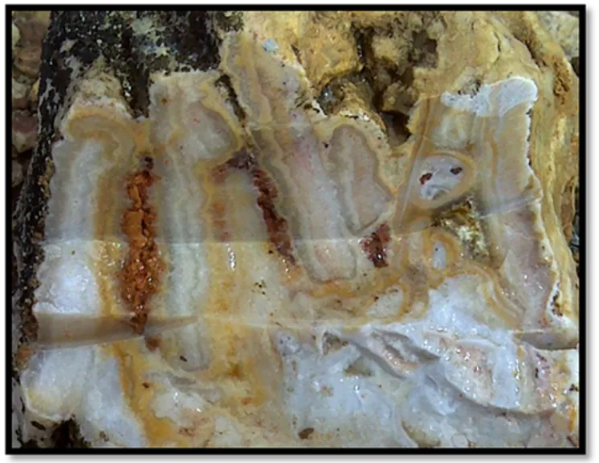
The four mineralized zones vary significantly in character in terms of geology. The Vetas Hermanas zone includes the site of the initial discovery and is characterized by 900 m of low sulphidation, banded, crustiform and cockade texture veins which are hosted largely in andesite flows. The veins in this zone vary in strike between 350° to 20° and are intermittent, with sampling being based on interpolation of outcrops into areas of sub crop and float.
The Domos de Piedra Negra Zone is represented by an east – west extension of 280 m of anomalous Au in veins and stockworks hosted in rhyolitic dome material. Whilst the extension of mineralization is generally east-west and north-south in this zone, individual veins strike west-northwest, which is more typical of the orientation of mineralization in other parts of the massif. Of the 77 surface samples reported in this zone, the average Au grade is 0.179 ppm and this is accompanied by averages of 84 ppm Pb, 13 ppm As, and 225 ppb Hg, with the Hg being calculated from the 38 surface samples where cool vapor analysis was available,
First pass drilling, comprising 860 m of diamond drilling in 9 short holes, was completed in December 2018, with results received in February 2019. Collar locations are illustrated in Figure 3, over an induced polarization resistivity map at 90 m depth. The first pass campaign partially tested the Elizabeth vein at the southern edge of the Puyatono Dome Area. The Company also tested the Vetas Hermanas Area and the Domos de Piedra Negra down to approximately 100 m. The Vetas Ocultas Area remains un-tested.
Drill hole PN_DDH006 intersected 2.0 m of 0.655 g/t Au (from metre 14 to 16) and then 1.0 m of 0.18 g/t Au (from metre 26 to 27). The hole collared in argillized tuffs, and after 14 m, cut low sulphidation vein material. Further anomalous intercepts are reported in drill holes PN_DDH001, 2, 4, and 7, and occur over an area of 700 by 500 m in the Vetas Hermanas and Puyutano Dome areas.
Chalcedonic silica in gold-bearing intercepts along with a pervasive Illite Sericite alteration, combine to indicate that the drilling was restricted to the upper part of a low sulphidation epithermal system, implying further target potential at depth. Additionally, strong Hg anomalies, between 2 and 4 ppm in drill hole PN_DDH008 appear to form part of a regional pattern which relates the Piedra Negra Veins to the discovery vein at Covadonga, 9 km to the west.